



English
- Details
- Written by: Natanael Dobra
- Category: English
- Hits: 879
Voicing Minimal Pairs - Word Bank
The Voicing Minimal Pairs - Word Bank is a specialized resource designed for speech-language pathologists, educators, and researchers to support speech and language therapy, particularly for addressing phonological disorders related to voicing contrasts. This database contains English minimal pairs—words differing by a single phoneme, such as base–pace (/b/ vs. /p/) or sheath–sheathe (/θ/ vs. /ð/)—where the differing phonemes are voiced versus voiceless counterparts (e.g., /p/ ↔ /b/, /t/ ↔ /d/, /s/ ↔ /z/). It is used in the conventional minimal pair approach to help individuals, especially children, distinguish and produce voicing contrasts through auditory discrimination and production practice, correcting errors like devoicing (e.g., saying pig for big). The word bank was created from a custom-built database of approximately 8,000 unique English words, thoughtfully curated over several years to ensure a robust and diverse set of pairs, supporting a wide range of speech and language therapy needs, from articulation practice to phonological research and English language instruction.
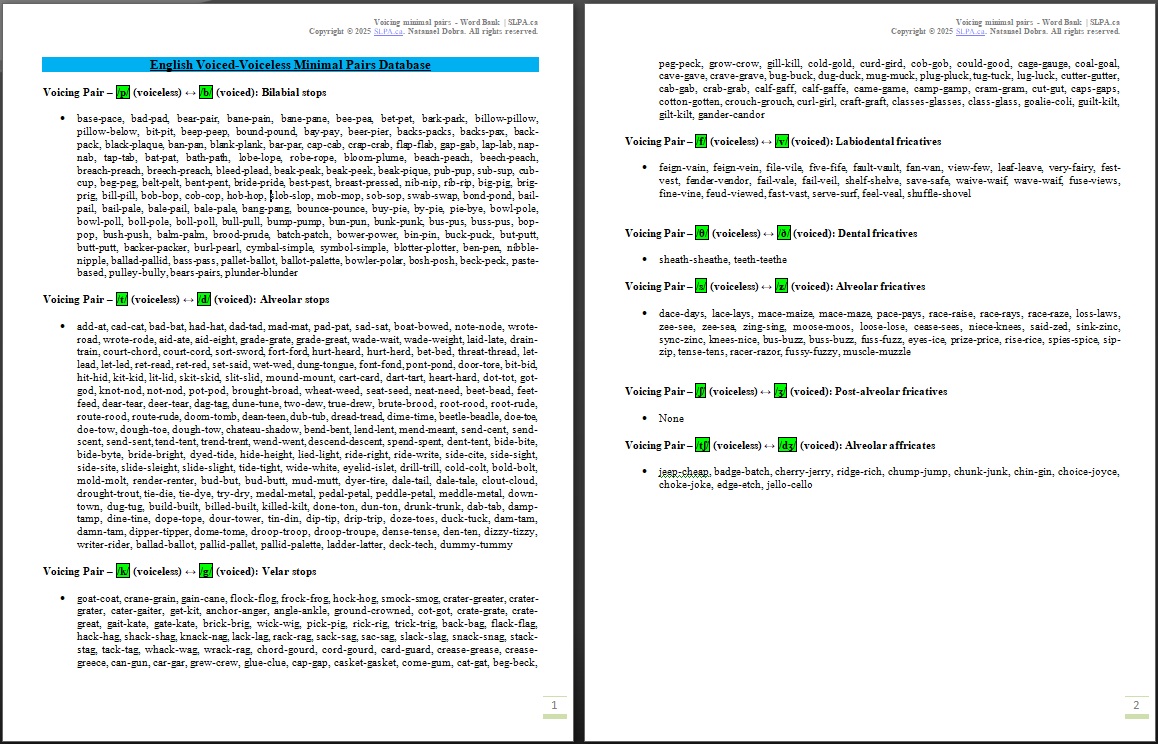
Voicing Minimal Pairs - Word Bank → Download Word Bank (PDF)
- Details
- Written by: Natanael Dobra
- Category: English
- Hits: 1943
This section is your comprehensive hub for everything related to English approximant sounds—/l/, /r/, /w/, and /j/ (as in "yes")—within the context of articulatory speech therapy. You'll find in-depth resources on how each sound is developed and practiced, including tongue placement cues, visual aids, and therapy strategies tailored to common challenges. Explore interactive online tools, downloadable PDFs, printable worksheets, and word banks specifically designed for approximant sounds. Whether you're a speech-language pathologist, educator, or parent, this section offers everything needed to support clear, confident speech using these fluid, often tricky sounds.
Approximants are speech sounds made by bringing two speech organs close together, but not close enough to create turbulent airflow or friction. They are smoother and more vowel-like than other consonants. English approximants include /w/, /j/ (as in "yes"), /l/, and /ɹ/ (as in "red"). These sounds are all voiced and are often used in speech to create smooth transitions between other sounds.
- "L" /l/ – Voiced Alveolar Lateral Approximant - by syllable & position → Download /l/ Word List (PDF)
- "R" /ɹ/ – Voiced Post-Alveolar Approximant - by syllable & position → Download /ɹ/ Word List (PDF)
- "Y" /j/ – Voiced Palatal Approximant - by syllable & position → Download /j/ Word List (PDF)
- "W" /w/ – Voiced Labio-Velar Approximant - by syllable & position → Download /w/ Word List (PDF)


- Details
- Written by: Natanael Dobra
- Category: English
- Hits: 1452
This section is your comprehensive hub for everything related to English nasal sounds—/m/, /n/, and /ŋ/ (as in "sing")—within the context of articulatory speech therapy. You'll find detailed instructions on how each nasal sound is taught, including airflow techniques, visual cues, and step-by-step therapy methods. Access interactive online tools, downloadable PDFs, printable worksheets, and curated word banks focused on nasals. Whether you're a speech-language pathologist, educator, or parent, this section provides all the essential resources to support precise nasal sound production and effective communication.
Nasals
Nasals are sounds produced by completely blocking airflow in the mouth while allowing air to pass through the nose. The soft palate (velum) lowers to open the nasal passage, giving these sounds their characteristic resonance. In English, the nasal sounds are /m/, /n/, and /ŋ/ (as in "sing"). All nasal sounds in English are voiced, meaning the vocal cords vibrate during production.
- "M" /m/ – Voiced Bilabial Nasal - by syllable & position → Download /m/ Word List (PDF)
- "N" /n/ – Voiced Alveolar Nasal - by syllable & position → Download /n/ Word List (PDF)
- "Ng" /ŋ/ – Voiced Velar Nasal - by syllable & position → Download /ŋ/ Word List (PDF)


- Details
- Written by: Natanael Dobra
- Category: English
- Hits: 1337
This section is your comprehensive hub for everything related to English affricate sounds—/ʧ/ (as in "chop") and /ʤ/ (as in "jump")—within the context of articulatory speech therapy. You'll find detailed guidance on how these complex sounds are taught in therapy, including articulatory placement strategies, visual aids, and developmental cues. Dive into interactive online tools, downloadable PDF resources, printable worksheets, and targeted word banks for each affricate. Whether you're a speech-language pathologist, educator, or parent, this section equips you with all the tools necessary to support accurate production and confident communication of affricate sounds.
Affricates
Affricates are speech sounds that begin like plosives, with a complete blockage of airflow, but end like fricatives, with a gradual release that creates friction. This combination gives affricates a unique sound quality that blends stopping and squeezing air. In English, the two main affricates are /tʃ/ (as in "chop") and /dʒ/ (as in "jump"). /tʃ/ is voiceless, and /dʒ/ is voiced.
- "Ch" /tʃ/ – Voiceless Post-Alveolar Affricate - by syllable & position → Download /tʃ/ Word List (PDF)
- "J" /dʒ/ – Voiced Post-Alveolar Affricate - by syllable & position → Download /dʒ/ Word List (PDF)


- Details
- Written by: Natanael Dobra
- Category: English
- Hits: 2044
This section is your comprehensive hub for everything related to English fricative sounds—/f/, /v/, /s/, /z/, /ʃ/ (sh), /ʒ/ (as in "measure"), /θ/ (as in "think"), and /ð/ (as in "this")—within the context of articulatory speech therapy. You'll find in-depth guides on how each sound is taught in therapy, including visual prompts, sound placement cues, and evidence-based strategies. Explore interactive online tools, downloadable PDFs, printable worksheets, and curated word banks for every fricative. Whether you're a speech-language pathologist, teacher, or parent, this section offers everything you need to support clear and confident speech development.
Fricatives
Fricatives are speech sounds produced by narrowing the space between two speech organs to create continuous airflow and friction. Unlike plosives, the air is not completely blocked, but squeezed through a tight space, which creates a hissing or buzzing sound. In English, fricatives include /f/, /v/, /s/, /z/, /ʃ/ (as in "shoe"), /ʒ/ (as in "measure"), /θ/ (as in "think"), and /ð/ (as in "this"). Some are voiced (like /v/ and /z/), and others are voiceless (like /f/ and /s/).
- "F" /f/ – Voiceless Labiodental Fricative - by syllable & position → Download /f/ Word List (PDF)
- "V" /v/ – Voiced Labiodental Fricative - by syllable & position → Download /v/ Word List (PDF)
- "S" /s/ – Voiceless Alveolar Fricative - by syllable & position → Download /s/ Word List (PDF)
- "Z" /z/ – Voiced Alveolar Fricative - by syllable & position → Download /z/ Word List (PDF)
- "Sh" /ʃ/ – Voiceless Post-Alveolar Fricative - by syllable & position → Download /ʃ/ Word List (PDF)
- "Zh" /ʒ/ – Voiced Post-Alveolar Fricative - by syllable & position → Download /ʒ/ Word List (PDF)
- "Th" /θ/ – Voiceless Dental Fricative - by syllable & position → Download /θ/ Word List (PDF)
- "Th" /ð/ – Voiced Dental Fricative - by syllable & position → Download /ð/ Word List (PDF)
- "H" /h/ – Voiceless Glottal Fricative - by syllable & position → Download /h/ Word List (PDF)


